PlayCompass:Recursive Self-Improvement for Game Generation with Visually Grounded Evolving Rubrics

Fuxiang Zhai1Sixiang Chen1Tengjun Huang1Lei Zhu1,2,*

1The Hong Kong University of Science and Technology (Guangzhou)
2The Hong Kong University of Science and Technology
*Corresponding author

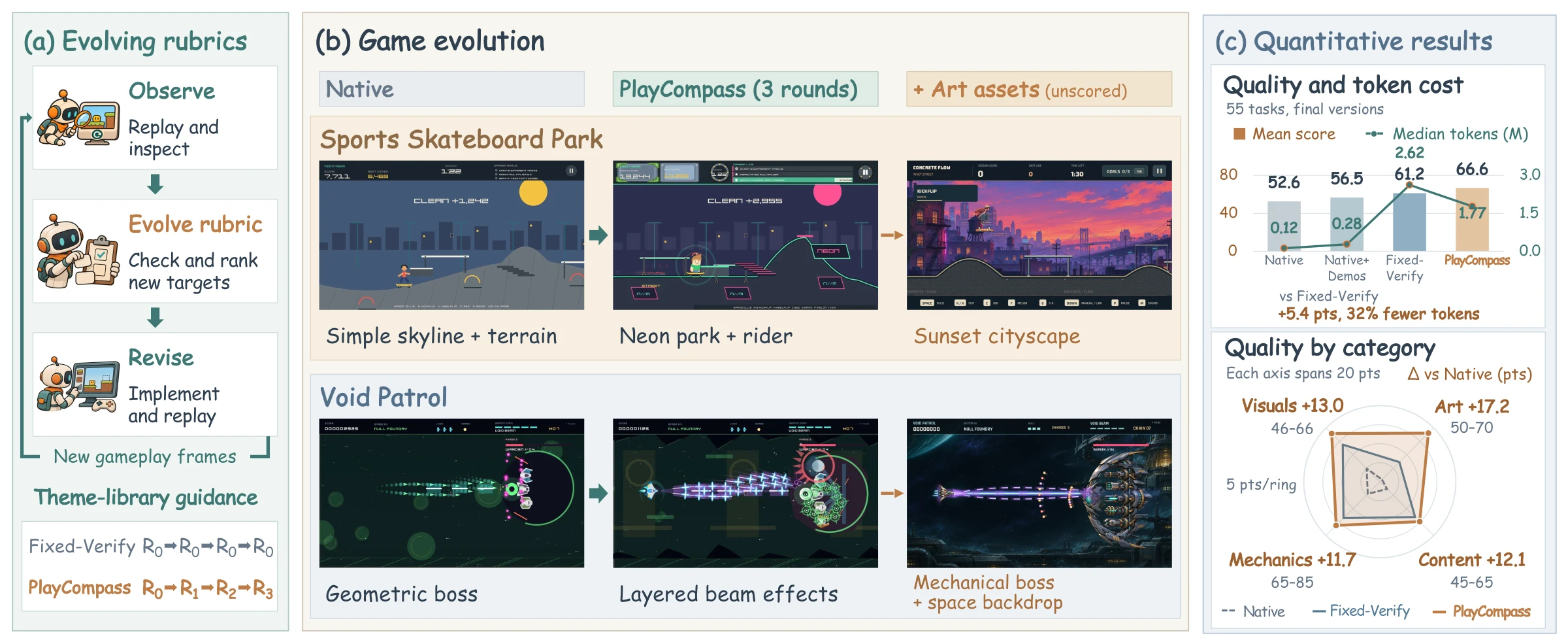
PlayCompass overview: evolving rubrics, game evolution over three rounds, and quantitative results
PlayCompass improves games by evolving visually grounded rubrics. (a) Rubrics evolve from replay frames and theme-library guidance to steer game revision. (b) Two Native games improve in just three PlayCompass rounds. The rightmost versions add art assets, are generated illustrations, and are not scored. (c) Across 55 tasks, PlayCompass gains 14.0 points over Native and outperforms the fixed-rubric loop by 5.4 points with 32% lower median billable token use (task means over two development runs for PlayCompass and the fixed-rubric loop).

Abstract

Coding agents can turn text briefs into playable games whose initial builds often lack content depth and visual polish. A fixed rubric can miss opportunities for improvement that emerge as a game changes, and short gameplay recordings can omit the states needed to verify an improvement.

We present PlayCompass, a training-free framework for recursive game development that pairs a fixed anchor rubric for core requirements with an evolving rubric for improvement targets. Each round, PlayCompass uses gameplay frames from the current build to propose new targets and check which targets have been met. It ranks open targets using a theme library distilled from scored tasks outside the evaluation set and frozen before evaluation. After each accepted revision, showcase demos capture the core loop and changes to inform the next rubric update.

On 55 GameCraft-Bench tasks with one model in every role, PlayCompass improves the native coding agent on every task, by 14.0 points on average, and outperforms a fixed-rubric loop by 5.4 points with 32% fewer tokens; human raters prefer its games on 25 of 30 tasks.
Method

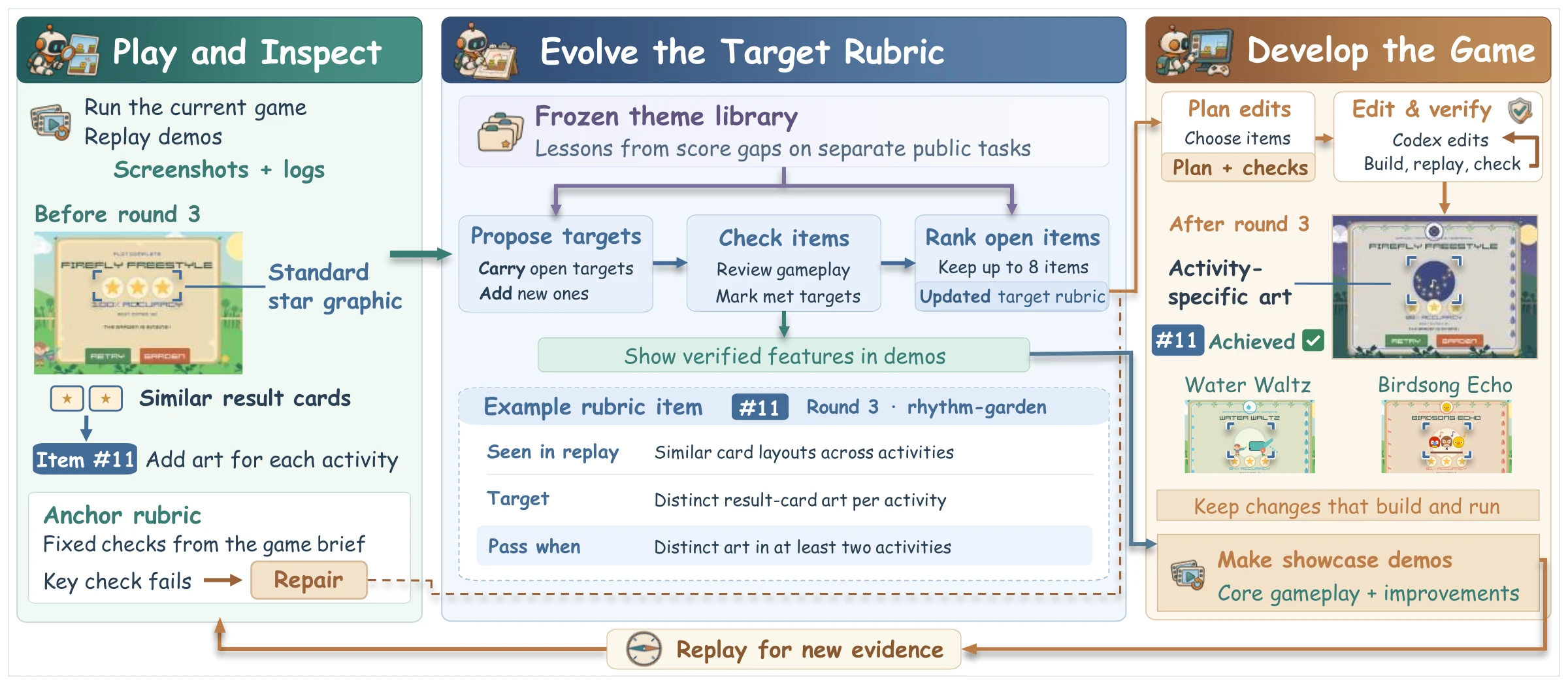
PlayCompass pipeline: play and inspect, evolve rubric, revise, present
PlayCompass evolves the game and its target rubric together. Gameplay frames guide target proposal and review, and a frozen theme library guides target proposal and ranking. The designer turns selected criteria into a development plan and an acceptance contract that specifies what should appear on screen and how to reach it. Showcase replays from the retained build provide fresh visual evidence for the next rubric update. In round 3 of rhythm-garden, similar result cards (left) motivate target #11 (center); Water Waltz and Birdsong Echo replays (right) show distinct result-card illustrations in at least two activities, satisfying the criterion. The gray panel shows generated illustrations, not results.
  1. Anchor rubric. A fixed rubric written from the game brief keeps the core requirements in view and guides repairs.
  2. Evolving rubric. Each round, a reviewer reads gameplay frames from the current build, proposes new improvement targets, and checks which open targets are met. Each pass or fail cites supporting frames or log lines.
  3. Theme library. Open targets are ranked with 23 reusable, genre-tagged themes. The themes come from comparing higher- and lower-scoring versions of public tasks outside the evaluation set, and the library is frozen before evaluation.
  4. Revise and present. The coding agent pursues the selected targets. After each accepted revision, a presenter records showcase demos of the core loop and the visible changes, and their replays supply the evidence for the next rubric update.

Results

+14.0points over the native coding agent, which improves on all 55 tasks
+5.4points over Fixed-Verify, a fixed-rubric refinement loop
−32%median billable tokens per task compared with Fixed-Verify
25 / 30tasks preferred by human raters in a blind video study
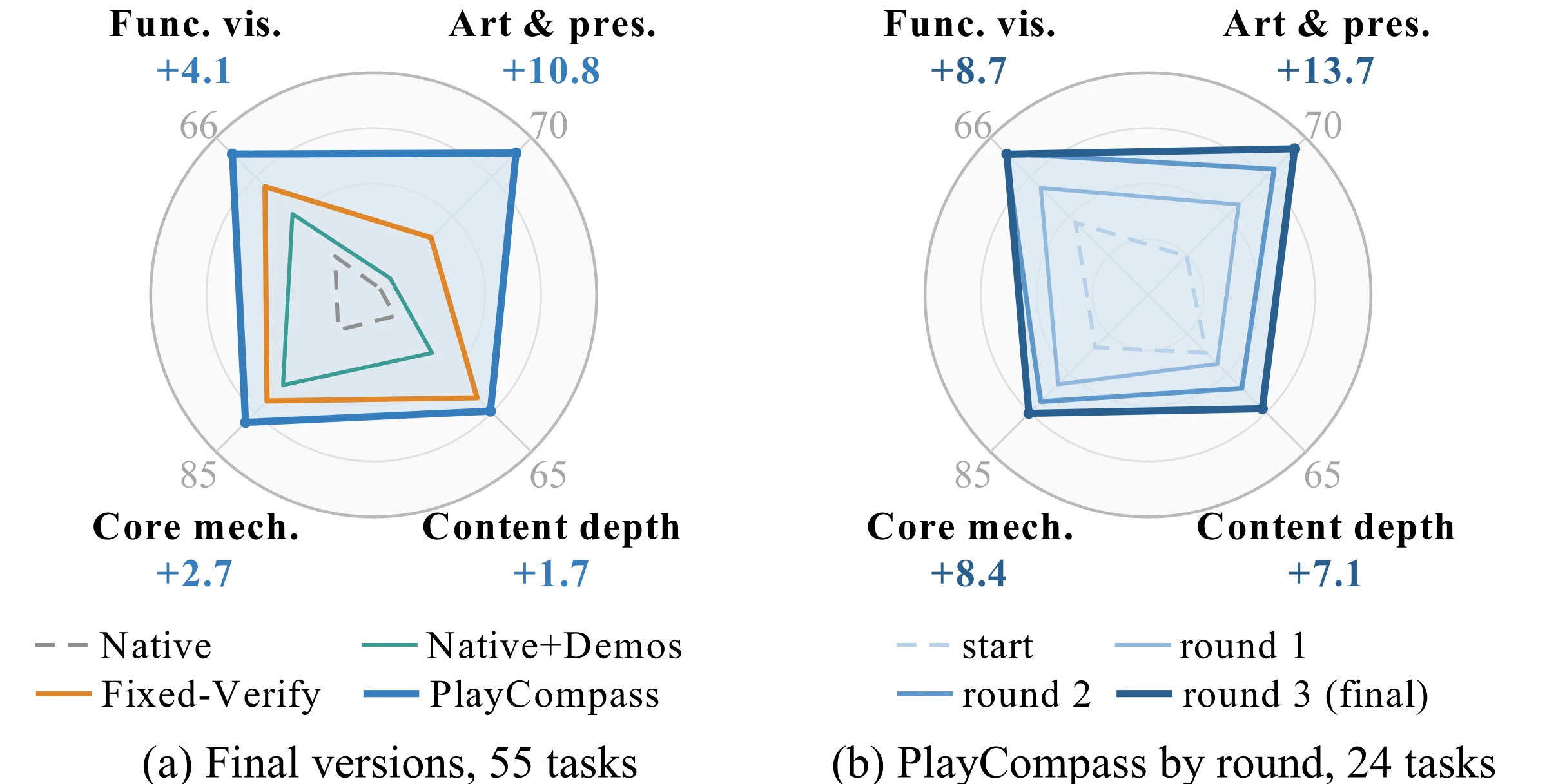
Category profiles of final versions and of PlayCompass after each round
Category profiles (task means, points; each axis spans 20 points). (a) Final versions on the 55 main tasks; numbers give PlayCompass minus Fixed-Verify. (b) PlayCompass after each round on the 24 ablation tasks; numbers give final minus start.

BibTeX

@misc{zhai2026playcompass,
  title  = {PlayCompass: Recursive Self-Improvement for Game Generation with Visually Grounded Evolving Rubrics},
  author = {Zhai, Fuxiang and Chen, Sixiang and Huang, Tengjun and Zhu, Lei},
  year   = {2026}
}