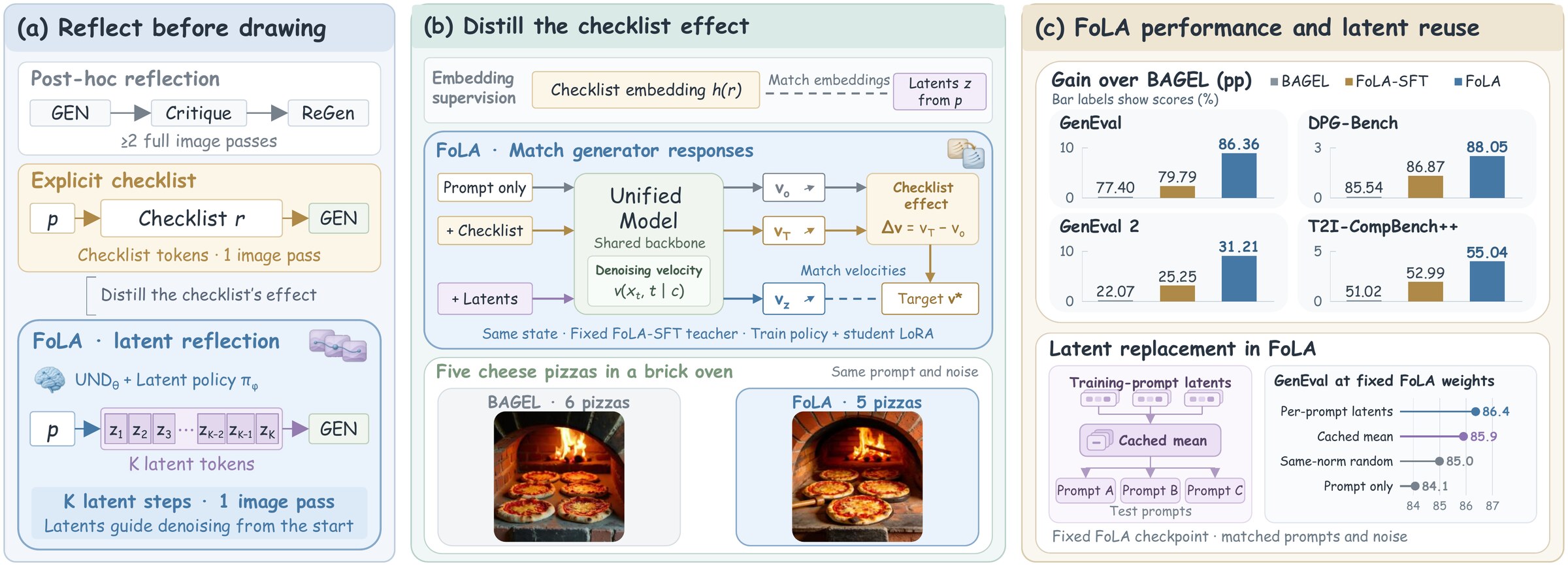
+8.96
GenEval over BAGEL
+9.15
GenEval 2 over BAGEL
+2.51
DPG-Bench over BAGEL
+4.01
T2I-CompBench++ over BAGEL
1The Hong Kong University of Science and Technology (Guangzhou)
2The Hong Kong University of Science and Technology
fzhai598@connect.hkust-gz.edu.cn
Unified multimodal models can identify visual requirements in a prompt that their generators still miss. A prompt-derived checklist can help by making those requirements explicit before denoising. Explicit checklists add text decoding for each prompt. In our comparison, matching pooled checklist hidden states yields no clear gain on GenEval or GenEval 2. We introduce FoLA (Forethought with Latent Actions) to internalize the checklist's effect on the generator as latent guidance. At each sampled state on the student's denoising trajectory, a fixed teacher predicts velocities from the prompt alone and from the same prompt with the checklist appended. We use the difference between these predictions to amplify the checklist's effect in a training target for jointly optimizing the latent policy and the student's generation LoRA. At inference, the policy writes latent tokens once from the prompt before denoising, and the generator uses the same latent context throughout a single generation pass. Under matched evaluation, joint FoLA improves over both the released BAGEL weights and the FoLA-SFT initialization on all four benchmarks. Relative to BAGEL, FoLA gains 8.96 points on GenEval, 9.15 on GenEval 2, 2.51 on DPG-Bench, and 4.01 on T2I-CompBench++. Among FoLA-SFT failures detected by BAGEL's understanding branch, FoLA fixes 39%, versus 26% for explicit checklists.
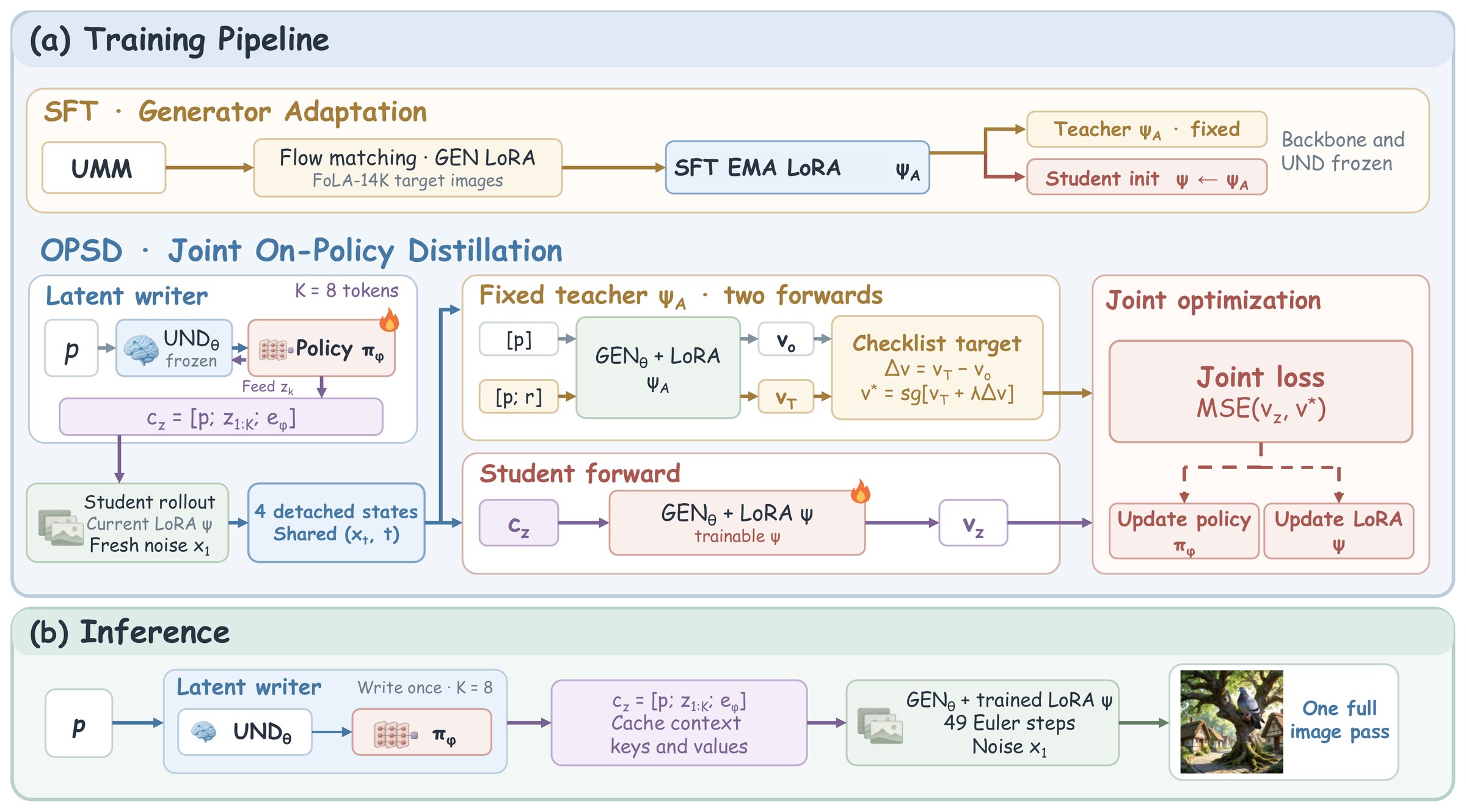
Matched protocol: same prompts, generation batches and initial noise for every method. All OPSD variants start from FoLA-SFT and share the fixed teacher, velocity target and 1,016-update budget.
| Variant | GenEval | DPG-Bench | GenEval 2 | T2I-CompBench++ |
|---|---|---|---|---|
| BAGEL (released) | 77.40 | 85.54 | 22.07 | 51.02 |
| FoLA-SFT | 79.79 | 86.87 | 25.25 | 52.99 |
| Policy only (FoLA-P) | 85.12* | 87.71* | 29.93* | 54.33* |
| LoRA only (FoLA-L) | 85.27* | 87.37 | 30.77* | 54.84* |
| Joint, latents off | 84.07* | 87.87* | 30.05* | 54.53* |
| Joint (FoLA) | 86.36* | 88.05* | 31.21* | 55.04* |
*: paired 95% bootstrap CI of the gain over FoLA-SFT lies above zero. GenEval 2 reports the Soft-TIFA geometric mean; T2I-CompBench++ reports the mean of eight categories.
FoLA-SFT GenEval failures (same prompt, image index and noise). Noticed: BAGEL's understanding branch answers "no" to a requirement that GenEval marks as failed.
| Method | Fixed, noticed (n=112) | Fixed, not noticed (n=121) | Broken passes (n=873) |
|---|---|---|---|
| FoLA-SFT, guidance 6 | 1.8 | 28.1 | 3.3 |
| FoLA-SFT + own checklist | 25.9 | 45.5 | 3.8 |
| FoLA-SFT + generic sentence | 26.8 | 45.5 | 4.2 |
| FoLA-P | 36.6 | 54.5 | 5.0 |
| FoLA-L (LoRA only) | 35.7 | 59.5 | 5.4 |
| FoLA, latents off | 27.7 | 51.2 | 4.9 |
| FoLA | 39.3 | 61.2 | 4.7 |
Percentages. Broken: FoLA-SFT passes and the method fails.
@article{zhai2026fola,
title = {FoLA: Latent Forethought Guides Unified Image Generation},
author = {Zhai, Fuxiang and Chen, Sixiang and Huang, Tengjun and Li, Yingjin and Zhu, Lei},
journal = {arXiv preprint},
year = {2026}
}